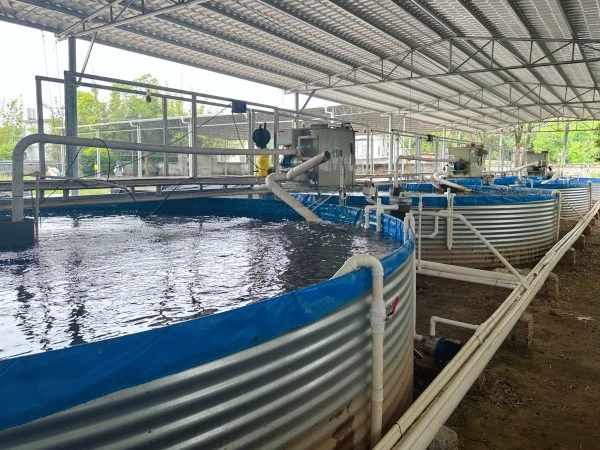
What is an independent modular recirculating aquaculture system?

An independent modular RAS aquaculture system refers to a system where each RAS aquaculture unit has its own independent filtration system. The water in each aquaculture tank is isolated from the others, achieving absolute aquaculture biosecurity. Construction, installation, and management can all be carried out independently and modularly.

This is a significant difference from traditional land-based recirculating aquaculture systems. Although it is also a closed-loop aquaculture system, but the central filtration system collects all the wastewater, filters it, and then sends it to each aquaculture unit, which makes the system very risky.

Components of Independent Modular RAS Aquaculture System

aquaculture tanks of Independent modular RAS aquaculture system

Commercial Aquaculture Tanks

We can provide aquaculture tanks of various types and sizes to suit different scales of RAS systems and aquaculture species.

Round Modular PP Tank, Round Galvanized Tank, as well as various rectangular tanks and Poly material Tanks.

Learn more
aquaculture aeration systems

High-efficiency Aquaculture Aeration Systems

We offer pure oxygen aeration systems, Roots blower aeration systems, and vortex blower aeration systems.

We can design the most suitable and efficient aeration system according to your project needs.

Learn more
aquaculture filtration equipment

Modular Aquaculture Filtration Systems

Our core technology is the modular filtration system, which consists of a centrifugal filter, a compass filter, and a small-scale biological filtration system.

The centrifugal filter has a filtration precision of 18-25 microns, and the compass filter has a filtration precision of 38-48 microns, placing our physical filtration precision among the highest in the global aquaculture industry.

Learn more

Water Quality Monitoring System

We provide aquaculture test kits, handheld water quality meters, and real-time remote monitoring systems.

You can flexibly choose a water quality monitoring system solution based on your aquaculture scale and budget.

Learn more
aquaculture ozone disinfection system

Aquaculture Ozone Disinfection System

Ozone systems are not recommended for all Ras aquaculture systems; they are only necessary for extremely high stocking densities.

We will design an efficient and safe ozone disinfection system based on your stocking density and species.

Learn more
aquaculture temperature control equipment

Aquaculture Temperature Control Systems

Temperature control systems need to be designed according to different aquaculture species and ambient temperatures; heating systems and chiller systems differ.

Please contact us for professional water temperature control system design.

Learn more
aquaculture automatic feeding system

Aquaculture Automatic Feeding Systems

We designed separate automatic feeders for fish and shrimp. We also have special models designed for fish fry and trout.

The feeding system is not the key component of the RAS aquaculture system, but it can save on labor costs and improve feed utilization.

Learn more

Modular Commercial RAS Aquaculture System Design Scheme Selection

Pilot Mini Modular RAS aquaculture system design

FSRAS-10P

Pilot Mini Modular RAS aquaculture system design

Main applications: Designed specifically for beginners or pilot projects, this small system boasts comprehensive functionality, including our core physical filtration system and pure oxygen system.

Design Features: The entire system is specially designed so that all components are plug-and-play, requiring no complex installation.

EXW Price: USD7000-8000

Request Our Latest Price
ModelFSRAS-10P
Total water capacity10m3
Fish output500kg-750kg
Aquaculture tanksΦ220cm*140cm
Tanks quantity2 sets
Tanks materialPP
Filtration flow5-20m3/h
Area occupied5.5m*4m
Electricity demand1.8kWh
No. of filtration systems1 set
Sewage discharge rate2-5%
Core EquipmentParametersCore Functions
Gravity compass filterFiltration accuracy 38-48 micronsPrimary physical filtration
Gravity dynamic filtrationUltraviolet disinfection
Centrifugal drum filterFiltration accuracy 18-25 micronsHigh-precision physical filtration
Centrifugal filtrationUltraviolet disinfection
Degassing
Bio filter media-mbbrSurface area:>1500 m²/m3Biological filtration
Biological tankΦ120 H:160cmFilter media container
Water pumpVariable frequency 150WWastewater circulation
Vortex blowerMaximum air flow:1.4m3/MBiological aeration
Oxygen generatorOxygen output: 5L/minPure oxygen aeration
Small-scale Modular RAS aquaculture system design

FSRAS-20F/40F/70F

Small-scale Modular RAS aquaculture system design

Main applications: specifically designed for fish and shrimp fry, or temporary holding projects.

Design Features: The entire system takes into account the characteristics of fish fry and temporary holding, with low feed intake and reduced requirements for the filtration system. We specifically designed one filtration system for four aquaculture tanks to reduce investment and power consumption.

EXW Price: USD11,000-13,000

Request Our Latest Price
ModelFSRAS-20FFSRAS-40FFSRAS-70F
Total water capacity20m340m370m3
Fish output1-1.5Ton2-3Ton3.5-5.2Ton
Aquaculture tanksΦ220cm*140cmΦ300cm*143cmΦ400cm*143cm
Tanks quantity4 sets4 sets4 sets
Tanks materialPPGalvanized stock tank
Filtration flow15-30m3/h30-40m3/h50-80m3/H
Area occupied7m*5m9m*7m12m*9m
Electricity demand2.6kWh3.3kWh3.9kWh
No. of filtration systems1 set
Sewage discharge rate2-5%
Core EquipmentParametersCore Functions
Gravity compass filterFiltration accuracy 38-48 micronsPrimary physical filtration
Gravity dynamic filtrationUltraviolet disinfection
Centrifugal drum filterFiltration accuracy 18-25 micronsHigh-precision physical filtration
Centrifugal filtrationUltraviolet disinfection
Degassing
Bio filter media-mbbrSurface area:>1500 m²/m3Biological filtration
Biological tankΦ120-Φ180 H:160-170cmFilter media container
Water pumpVariable frequency 400W-800WWastewater circulation
Vortex blowerMaximum air flow:1.4m3/MBiological aeration
Oxygen generatorOxygen output: 10-20L/minPure oxygen aeration
Grow-out Modular RAS aquaculture system design

FSRAS-80S/160S/320S/900S

Grow-out Modular RAS aquaculture system design

Main applications: Suitable for over 95% of species, especially fish with a harvest weight under 2 kg and all shrimp.

Design Features: The most basic unit is the 80S, a standard grow-out system for ras fish farming. This design offers optimal filtration speed, investment, and yield. The 160S, 320S, and 900S are yield multiples of the 80S.

EXW Price: USD12,000-128,000

Request Our Latest Price
ModelFSRAS-80SFSRAS-160SFSRAS-320SFSRAS-900S
Total water capacity80m3160m3320m3960m3
Fish output4-6Tons8-12Tons16-24Tons48-72Ton
Aquaculture tanksΦ600cm*143cm
Tanks quantity2 sets4 sets8 sets24 sets
Tanks materialGalavnized Tank
Filtration flow50-80m3/H100-160m3/H200-320m3/H600-960m3/H
Area occupied15m*6m15m*14m30m*14m45m*28m
Electricity demand3-4kWh6-8.9kWh10-13.6kWh24-36kWh
No. of filtration systems1 set2 set4 set12 set
Sewage discharge rate2-5%
Core EquipmentParametersCore Functions
Gravity compass filterFiltration accuracy 38-48 micronsPrimary physical filtration
Gravity dynamic filtrationUltraviolet disinfection
Centrifugal drum filterFiltration accuracy 18-25 micronsHigh-precision physical filtration
Centrifugal filtrationUltraviolet disinfection
Degassing
Bio filter media-mbbrSurface area:>1500 m²/m3Biological filtration
Biological tankΦ180 H:170cmFilter media container
Water pumpVariable frequency 800WWastewater circulation
Vortex blowerMaximum air flow:1.4-5.3m3/MBiological aeration
Oxygen generatorOxygen output: 20-180L/minPure oxygen aeration
Large-scale Modular Tilapia RAS system design

FSRAS-500/1000/2000

Large-scale Modular Tilapia RAS system design

Main applications: For tilapia and trout, this design slows down the filtration rate and incorporates a larger fish tank.

Design Features: This is highly advantageous for large-scale tilapia farming, allowing us to reduce investment costs and energy consumption while ensuring high yields.

EXW Price: USD50,000-220,000

Request Our Latest Price
ModelFSRAS-500FSRAS-1000FSRAS-2000
Total water capacity560m31100m32200m3
Fish output28-39Ton56-78Ton112-156Ton
Aquaculture tanksΦ800cm*143cm
Tanks quantity8 sets16 sets32 sets
Tanks materialGalvanized stock tank
Filtration flow200-320m3/H400-640m3/H800-1280m3/H
Area occupied36m*20m40m*36m80m*36m
Electricity demand13-16.4kWh26-32.4kWh52-64kWh
No. of filtration systems4 set8 set16 set
Sewage discharge rate2-5%
Core EquipmentParametersCore Functions
Gravity compass filterFiltration accuracy 38-48 micronsPrimary physical filtration
Gravity dynamic filtrationUltraviolet disinfection
Centrifugal drum filterFiltration accuracy 18-25 micronsHigh-precision physical filtration
Centrifugal filtrationUltraviolet disinfection
Degassing
Bio filter media-mbbrSurface area:>1500 m²/m3Biological filtration
Biological tankΦ200 H:170cmFilter media container
Water pumpVariable frequency 800WWastewater circulation
Vortex blowerMaximum air flow:1.4-9m3/MBiological aeration
Oxygen generatorOxygen output: 100-400L/minPure oxygen aeration

Summary Table of Model Parameters

Model No.Total Water CapacityFish OutputTank SizeTanks QtyFiltration FlowDaily drainageArea occupiedElectricity demand
m3One cyclecmpcsm3/h%Length*WidthKWH
FSRAS-10P10m3500kg-750kgΦ220*14025-20m3/h≤3-55.5m*4m1.8KWH
FSRAS-20F20m31-1.5TonΦ220*140415-30m3/h≤3-57m*5m2.6KWH
FSRAS-40F40m32-3TonΦ300*143430-40m3/h≤3-59m*7m3.3KWH
FSRAS-70F70m33.5-5.2TonΦ400*143450-80m3/H≤3-512m*9m3.9KWH
FSRAS-80S80m34-6TonsΦ600*143250-80m3/H≤3-515m*6m3-4KWH
FSRAS-160S160m38-12TonsΦ600*1434100-160m3/H≤3-515m*14m6-8.9KWH
FSRAS-320S320m316-24TonsΦ600*1438200-320m3/H≤3-530m*14m10-13.6KWH
FSRAS-900S960m348-72TonΦ600*14324600-960m3/H≤3-545m*28m24-36KWH
FSRAS-500560m328-39TonΦ800*1438200-320m3/H≤3-536m*20m13-16.4KWH
FSRAS-10001100m356-78TonΦ800*14316400-640m3/H≤3-540m*36m26-32.4KWH
FSRAS-20002200m3112-156TonΦ800*14332800-1280m3/H≤3-580m*36m52-64KWH

1. All the above equipment can be customized according to your local voltage, such as 110V/60Hz, 220V/50Hz, 220V/60Hz, 380V/50Hz, 380V/60Hz, 400V/50Hz, 400V/60Hz

2. All system models can be expanded to include:

※ Water Quality Monitoring System
※ Ozone Disinfection System
※ Heating Systems and Chiller Systems
※ Automatic Feeding System
※ PLC Aquaculture Automation

Modular recirculating aquaculture system for sale and consulting

Get Our Latest Price

Your high ROI Ras project

Why buy our Modular RAS aquaculture system?

  • The Modular Ras solution utilizes our centrifugal filter and Compass dynamic filter, our core technologies, which hold patent certifications in the EU, China, the US, Japan, Australia, and Singapore.
  • The centrifugal filter and Compass dynamic filter ensure the physical filtration efficiency of the entire system, allowing for highly efficient independent operation. This effect cannot be achieved by using ordinary drum filters or screen filters.
  • Our independent modular system is a sustainable aquaculture system with minimal wastewater production, maintaining a daily discharge rate of only 2-5%. This is the best choice for water-scarce regions like the Middle East and for North America and Europe, where wastewater discharge regulations for aquaculture are stringent.
  • The highly efficient filtration system reduces disease incidence in aquaculture species and decreases the use of medications, which is particularly beneficial in the face of increasingly stringent regulations on aquatic products.

Our after-sales support

  • We offer more than just design solutions and equipment; we provide a comprehensive suite of construction, installation, and operation guidance.
  • For small projects, we can provide complete sets of drawings and online guidance. For medium to large-scale projects, we can send engineers to the site for on-site guidance.
  • We serve over 100 RAS farms and have our own large-scale RAS fish farming project. After cooperation, we can continuously share more of the latest fish and shrimp farming technologies and experience.
Get Solution

If the above Modular Ras models do not perfectly suit your project,We can also customize to your needs.

For customization, please provide the following information:

  • 1. Your farm location.
  • 2. Aquaculture species.
  • 3. Expected annual yield.
  • 4. Electricity supply.
  • 5. Water supply.

Below is a complete preliminary communication form. Please review and fill it out carefully. The more detailed the information you provide, the more comprehensive our solution will be.

Advantages of Independent Modular RAS System

Design Concept Comparison

Independent modular Aquaculture System diagram

 Independent Modular Aquaculture System Diagram

As we can see from the design drawings, our two aquaculture tanks utilize a complete filtration system, including a centrifugal filter, a compass filter, and a biofiltration tank.

The system design is simple, and each unit operates independently, making it very convenient to reduce or increase the number of tanks.

traditional closed recirculating aquaculture system images

Central Circulation Recirculating Aquaculture System Diagram

As seen in the design drawings, the 18 tanks utilize a central filtration system, including a submerged drum filter, a degassing tower, a protein skimmer, and a biofiltration tank.

The system design is complex; the entire system operates in series, and after the design phase, it cannot be operated independently or the number of culture tanks can be increased or decreased.

7 Core Technical Advantages in Modular RAS:Advanced smart aquaculture system

Independent modular RAS aquaculture system

✅Filtration accuracy: The centrifugal filter has a filtration precision of 18-25 microns. The compass filter has a filtration precision of 38-48 microns.

✅Filtering method: The centrifugal filter uses active centrifugal filtration. The compass filter uses gravity-driven dynamic filtration. It can withstand larger wastewater flow rates.

Traditional central filtration RAS aquaculture system

Filtration accuracy: Central filtration systems typically use rotary drum filters, which generally have a filtration accuracy of 75-125 microns.

Filtering method: The filtration method is passive, resulting in a very unsatisfactory filtration effect.

Independent modular RAS aquaculture system

✅Distance of sewage pipes: The Independent Modular System uses less piping; the wastewater pipe from the bottom of the fish tank to the filtration system is ≤10m.

✅Wastewater circulation time:The sewage pipes are separate and will not get blocked. Wastewater reaches the filtration system in just a few seconds.

Traditional central filtration RAS aquaculture system

Distance of sewage pipes: Traditional centralized systems use more piping; the wastewater pipe from the bottom of the fish tank to the filtration system is≥30m.

Wastewater circulation time: These wastewater pipes are connected in series, making them prone to clogging. Wastewater may take tens of seconds, or even minutes, to reach the filtration system.

Independent modular RAS aquaculture system

✅High-efficiency physical filtration: In an independent modular RAS, 90% of the waste generated is filtered by the physical system, with only 10% of smaller particles entering the biological filtration system.

✅More efficient biological filtration: Thanks to powerful physical filtration technology, ≥90% of particulate matter is separated, ensuring that only the smallest waste enters the biological filtration tank, significantly reducing the bioburden.

✅Simplified biological filtration system: Our modular design employs a streamlined and efficient biological filtration stage. This enhances nitrification stability while maintaining a smaller footprint.

Traditional central filtration RAS aquaculture system

Inefficient physical filtration: In centralized RAS systems, only 20% of the waste is filtered by the physical system, while the remaining 80% heavily relies on biological filtration.

High burden on biological filtration: Due to the inefficiency of mechanical filters, large particles can enter the biological filtration tank, significantly increasing the bioload and often necessitating the design of large-scale biological filtration systems.

Bulky biological filtration system: Traditional centralized systems often require oversized and clunky biofilters to compensate for a poor physical system.

Independent modular RAS aquaculture system

✅Powerful degassing system: Inside the centrifugal filter, wastewater is forcibly cut by the powerful centrifugal force and 18-micron filter screen. Unique centrifugal shearing technology transforms bulk water into a high-surface-area micro-mist, enabling rapid stripping of harmful gases such as Carbon Dioxide (CO2), Ammonia (NH3), and Hydrogen Sulfide (H2S) without the need for bulky degassing towers.

✅Integrated UV disinfection function: Both the centrifugal filter and the compass filter are equipped with high-power ultraviolet germicidal lamps. By fragmenting water into micro-droplets, we dramatically increase the UV exposure surface, ensuring maximum photonic penetration and total pathogen elimination at the microbial level.

Traditional central filtration RAS aquaculture system

Bulk degassing towers: Aquaculture produces large amounts of harmful gases such as carbon dioxide (CO2), ammonia (NH3), and hydrogen sulfide (H2S). Traditional systems require a sufficiently long water flow path or drop for effective degassing. This often necessitates large degassing towers, increasing the type of equipment and floor space required.

Additional UV sterilizers: In traditional systems, water flows through the center of the UV sterilizer. With a typical pipe diameter of 110-160mm, UV light cannot penetrate the water, creating many dead zones. Moreover, the water flow is fast, so even with a high-powered ultraviolet sterilizer, the effect is far from ideal.

Independent modular RAS aquaculture system

✅100% physical isolation: An independent, modular RAS aquaculture system with no water connections between units. Achieve 100% physical isolation.

✅Biosecurity Barrier: Viral and bacterial infections in a single aquaculture tank will not spread to other tanks, creating a biosecurity barrier.

✅Precision treatment: In the event of an infection, a single unit can provide effective point-to-point quarantine and better treatment.

Traditional central filtration RAS aquaculture system

Series integrated system: Traditional RAS aquaculture systems use a central filtration system to connect the water bodies between each unit, making physical isolation impossible.

No Biosecurity guarantees: Viral and bacterial infections in individual aquaculture tanks can lead to cross-infection vulnerability, with the central filtration system acting as a “distribution center” for pathogens.

Overall high risk: Once an infection occurs, the entire system is prone to collapse, requiring more time to identify the cause and necessitating a larger-scale treatment plan.

Independent modular RAS aquaculture system

✅Standard modular management: Individual units can be managed separately, offering low maintenance complexity, modularity, and standardization, reducing reliance on professional aquaculture personnel. We rely on data analysis.

✅On-demand Operation: Each unit can be managed according to aquaculture needs; some units can be shut down during the fry or harvesting periods. Furthermore, multiple aquatic species can be farmed simultaneously.

✅Energy saving: Energy consumption is flexibly managed, allowing for adjustments to the energy consumption of water pumps, filtration systems, and aeration systems based on different stages, such as fry, grow-out, and harvesting.

Traditional central filtration RAS aquaculture system

Complex management: Traditional central filtration (RS) systems are complex in design, with numerous devices and pipes, heavily reliant on professional aquaculture personnel, and require highly specialized operation teams. Novices cannot manage them independently.

High Idle Costs: The entire system is designed for maximum yield; it’s a complete system. Even with a 50% reduction in stocking density, the central filtration system still needs to operate at full power. Furthermore, it cannot support the simultaneous cultivation of multiple aquatic species.

Energy consumption is constant: The initial design of central filtration systems cannot simultaneously consider the oxygen and filtration requirements at different stages.

Independent modular RAS aquaculture system

✅Independent modular design: It can be added as needed, like building with Lego bricks.

✅Incremental investment plan: Reduces initial investment, allowing for scaling up production based on profitability and market demand, achieving a balance between investment and return.

✅Rapid installation and scalability: The modular design enables rapid installation and scaling up, and allows for cost-effective upgrades to existing systems.

Traditional central filtration RAS aquaculture system

Fixed Design: Once the design is finalized, subsequent modifications or increases in production capacity are extremely difficult.

High One-Time Investment: All infrastructure and equipment must be completed at the beginning of the project. This also applies to consumables such as fish and shrimp fry and feed. Capital tied up is very high, the return on investment period is long, and the risk is high.

High Difficulty in Expansion and Upgrades: Increasing aquculture tanks and production capacity requires redesigning the entire system. New technological upgrades also require high additional costs.

Modular RAS Aquaculture System Application Demonstration

RAS system fish farming pilot project

RAS system fish farming pilot

Learn more
indoor tilapia ras system farm

Indoor tilapia ras system farm

Learn more

Outdoor tilapia ras system

Learn more

Large-scale indoor bass ras system

Learn more
freshwater recirculation aquaculture systems

Acrossocheilus fasciatus ras fish farm

Learn more
Tilapia ras indoor fish farming

Tilapia ras indoor fish farming

Learn more
Large-scale tilapia recirculating aquaculture system

Large-scale red tilapia ras farm

Learn more
Large-scale indoor fish ras system farm

Large-scale indoor ras fish farm

Learn more
Freshwater fish fry farm

Freshwater fish fry farm

Learn more

Guide Collection on Modular Recirculating Aquaculture System

FAQ

Is an Independent Modular RAS a sustainable aquaculture system?

Yes, Independent Modular RAS is a type of land-based recirculating aquaculture system.

We use more advanced equipment and design concepts, which can reduce energy consumption and pollution rates by 2-5%, making it a more sustainable aquaculture system.

FUTURERAS is not just a RAS system supplier, but also a system design company and manufacturer.

Independent modular RAS is our core design philosophy, and we are the sole patent holder and manufacturer of centrifugal filters and compass filters.

Yes, we can provide on-site surveys, market analysis, solution design, equipment manufacturing and transportation, on-site construction, installation, and operation training for the entire project, according to your requirements.

A RAS aquaculture system quote requires many components.

We typically provide an initial quote within 3 days of receiving your detailed requirements.

A complete and detailed quote will be adjusted based on your site conditions and investment budget after further communication.

Shrimp farming differs from fish farming, having higher technological barriers. The shrimp larvae and shrimp farms we partner with are often unwilling to share their techniques, Therefore, we rarely display on the website.

We also have many RAS shrimp farming case studies; you can contact us to obtain them.